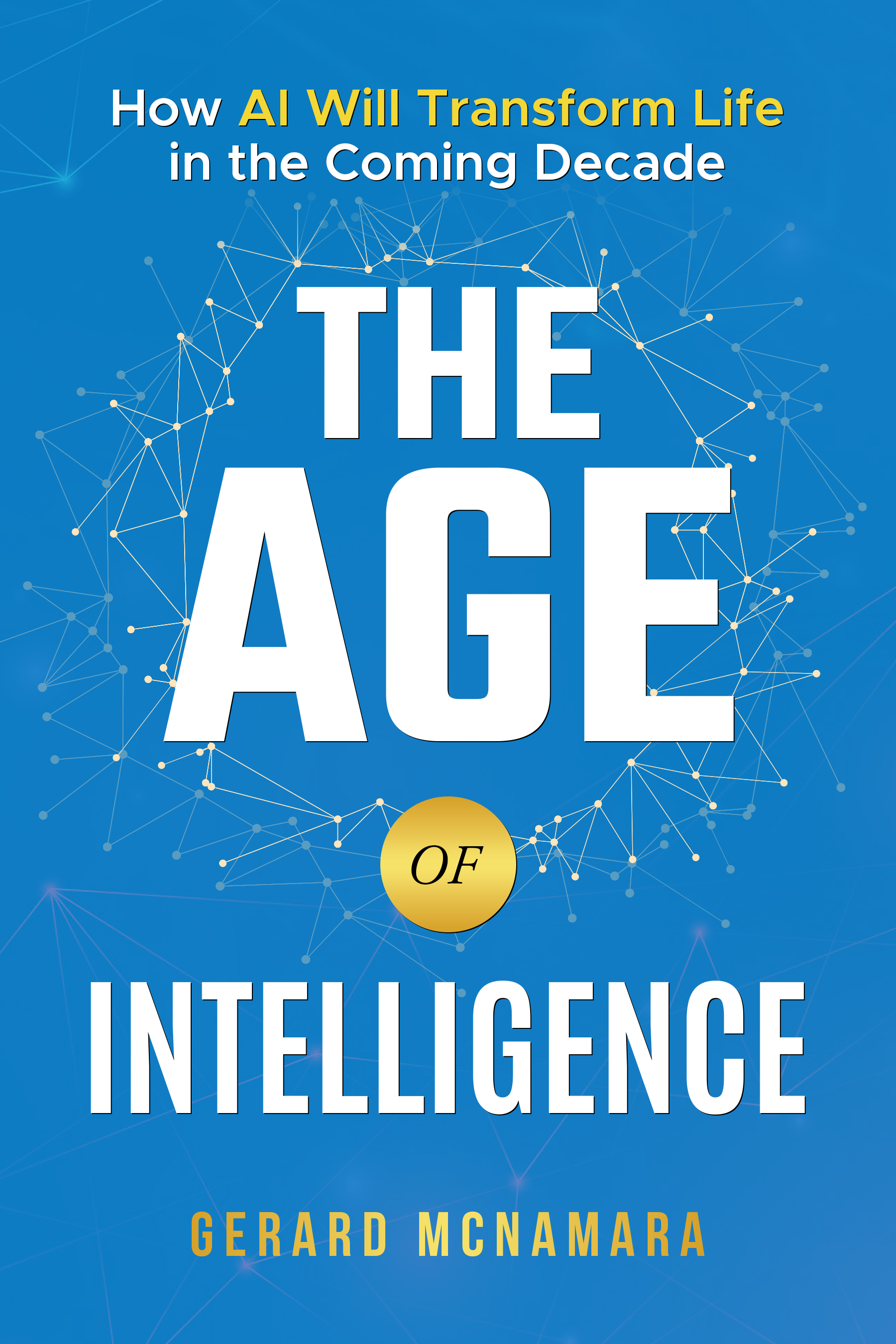
The Age of
Intelligence
How AI Will Transform Life in the Coming Decade
By Gerard McNamara
Artificial intelligence is becoming the infrastructure of modern life. This book asks the question most people are not yet asking: who will own it, who will control it, and what will that mean for the rest of us?
Why This Book Matters Now
AI is moving from being a tool into becoming part of the background systems of modern life. It is not arriving someday. It is already here.
AI is no longer experimental. It is already embedded in the systems that shape work, healthcare, finance, education, and public services.
Decisions that affect your life are increasingly made by systems you cannot see, challenge, or opt out of.
The next decade will determine whether AI serves the public interest or concentrates power in ways that prove extraordinarily difficult to reverse.
About the Book
“If intelligence becomes essential infrastructure, who gets to own it — and on what terms does the rest of society access it?”
Artificial intelligence is no longer experimental. It recommends, ranks, approves, denies, predicts, and optimises. It shapes what you see, what you're offered, what you're charged, and increasingly what you're allowed to do next. It sits beneath modern life the way electricity does: mostly invisible when it works, impossible to ignore when it fails.
Most books about AI focus on what it can do. This one asks who controls it — and who benefits.
Across healthcare, education, work, finance, transport, governance, and the intelligent home, Gerard McNamara shows how AI is becoming essential infrastructure — and how ownership of that infrastructure determines who sets the rules of participation in the emerging economic order.
This is not a dystopian warning. Nor is it a technological celebration. It is a clear-eyed account of the transformation already underway — and a case that the decisions made in this decade will determine whether AI serves broad public interests or concentrates structural power in ways that prove extraordinarily difficult to reverse.
Infrastructure, Not Just a Tool
AI is following the same pattern as railways, electricity, and telecommunications — a technology society becomes dependent on before ownership locks in.
Real People, Real Situations
Each chapter begins with a concrete scenario — a patient, a worker, a citizen — before stepping back to reveal the wider structural shift.
The Ownership Question
Who controls the systems that recommend, rank, approve, deny, and optimise? And on what terms does the rest of society access them?
Key Questions This Book Explores
The book's central strength is asking better questions than most AI books dare to raise.
What happens when AI becomes essential infrastructure?
Who owns the systems society depends on?
Will AI create broad prosperity or concentrate power?
How will AI reshape work, healthcare, education, finance and public services?
Can ordinary citizens challenge automated decisions?
What choices must we make before the rules are locked in?
Who This Book Is For
This is not a technical AI book. It is written for intelligent general readers who want to understand what is happening and what it means.
No technical background required.
What Readers Are Saying
Rated 4.9 out of 5 stars across 7 reviews
“This book reframes the entire AI conversation”
The central idea that AI is becoming infrastructure rather than just a tool completely reframed how I think about what’s happening. The comparison to electricity and earlier technological shifts isn’t just a metaphor—it’s a framework that holds up across every chapter.
“Readable, human, and quietly unsettling”
The “day in 2036” chapter pulled me in immediately. It didn’t feel futuristic—it felt plausible. That’s what makes this book powerful. It shows how AI will shape ordinary life, not just big industries.
“Essential reading for policymakers and leaders”
The argument that AI will act as “decision infrastructure” is one of the clearest and most important ideas I’ve encountered on this topic. It explains why the stakes are so high.
“Thought-provoking, even when I disagreed”
I didn’t agree with everything in this book—but I found myself thinking about it constantly, which is probably a stronger endorsement than agreement.
“A rare combination of clarity and depth”
The historical comparisons—fire, the wheel, metal, electricity—aren’t just decorative. They reinforce the central argument that transformative technologies follow patterns: discovery, adoption, dependence, and eventually control.
“Changed how I think about my own work”
It’s easy to think of AI as just improving productivity. This book shows that it’s doing something deeper—it’s shifting where decisions are made and who controls them.
“One of the most important books on AI right now”
Instead of focusing on what AI can do, it focuses on what happens when we start to depend on it—and who controls that dependency. That shift in perspective makes all the difference.
Help Other Readers Discover This Book
If the book helped you think differently about AI and the future, please consider leaving a short review. Reviews help independent authors reach new readers.
Gerard McNamara

Gerard McNamara has spent over thirty years in the high-volume electronics industry, building a career at the intersection of technology and business management. His work gave him a front-row seat to the cycles of transformation that define the sector — and a practitioner's understanding of how quickly the unimaginable becomes the everyday.
With more than a decade in computer hardware and a lifelong interest in computing, McNamara watched the industry evolve from the command-line days of DOS through the early graphical interfaces of Windows 3.1, the internet revolution, and into today's era of machine learning and generative AI. That long perspective is what shaped this book.
Having witnessed several waves of technological change from the inside, he recognised that the current AI transformation was following a familiar pattern — but at a speed and scale that demanded a different kind of attention. Not breathless enthusiasm, and not paralysing anxiety, but a clear-eyed look at who is building the systems, who will own them, and what that means for the rest of us.
The Age of Intelligence is a book written not from the academy or the start-up pitch deck, but from decades of watching how technology actually embeds itself into industries, institutions, and daily life. It speaks to the intelligent general reader — the person who knows something important is changing and wants to understand what it is. McNamara lives in Ireland. This is his first book.
30+ Years in Tech
Career spanning the electronics industry
Industry Insider
From DOS to generative AI, first-hand
Clear-Eyed View
Beyond hype and fear — practical truth
Accessible Writing
For ordinary readers, not specialists
25 Chapters Across 5 Parts
From the foundations of human progress to the choices that will shape our future
A Day in 2036: Living With Intelligence
Part One: The Foundations of Progress
Fire: The First Technology Revolution
The Wheel: The First Revolution in Movement
Metal and Tools: Shaping Civilization
The Power Revolutions: Steam and Electricity
The Intelligence Age: Computers and AI
Part Two: AI in Daily Life
The Intelligent Home
AI Companions: When Loneliness Meets Intelligence
Transportation: A World That Moves Itself
Part Three: AI in Society
The Healthcare Revolution: Medicine Meets Intelligence
AI and Mental Health: The Crisis and the Cure
Education Reimagined: Learning That Adapts to You
Work and Purpose: When Intelligence Transforms Labour
Aging with Dignity: Intelligence That Enables Independence
Safety and Security: Intelligence That Protects
Part Four: AI in the World
Smart Cities: Living Inside Intelligence
Creativity Unleashed: AI as the Artist's Partner
Finance and Wealth: When Money Meets Intelligence
AI and the Environment: The Paradox of Intelligent Sustainability
The Global Economy: Intelligence Reshaping Production, Trade, and Power
Part Five: The Choice Ahead
The Dark Side: Risks, Harms, and Hard Questions
Freedom and Control: The Technology That Empowers and Enables Surveillance
AI and Democracy: When Intelligence Meets Governance
What We Must Do: Choices That Will Shape the Next Century
The Future We Choose: Two Paths Ahead
Books by Gerard McNamara
Exploring how artificial intelligence will reshape every aspect of our lives
The Age of Intelligence
How AI Will Transform Life in the Coming Decade
The Future of Work, Power, and Society in the AI Era. Most books about AI focus on what it can do. This one asks who controls it — and who benefits.
Order on Amazon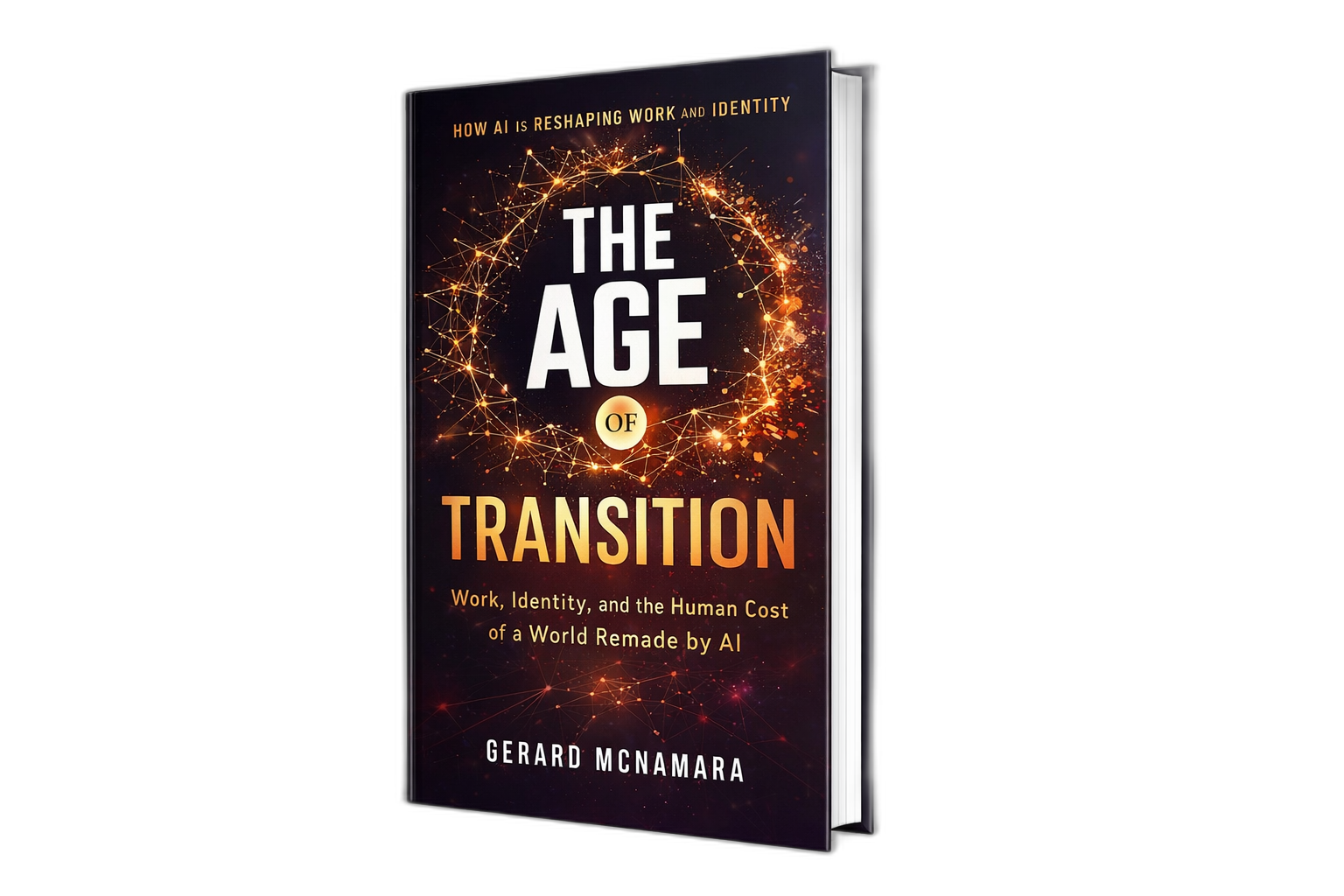
The Age of Transition
How AI Will Transform Work and Identity in the Coming Decade
The first book asked who owns AI. This one asks what it does to us — our work, our identity, and our sense of purpose.
Learn MoreOrder Your Copy
Available now on Amazon in eBook, paperback, and hardcover formats.
Kindle
eBook Edition
Paperback
Print Edition
Hardcover
Premium Edition
Stay updated on AI, society, work and the future
Get occasional updates from Gerard McNamara, including new articles, reader notes, and updates on The Age of Transition.
Free download included
10 Questions Everyone Should Ask About AI Before 2030
Watch Gerard on AI and the Future
Video discussions on AI, society, work, power and the future are coming soon. Subscribe to be notified when new episodes are available.
Contact Gerard
Whether you have a question, a reflection, or an invitation — I'd love to hear from you.
Reader Feedback
Questions about the book, reflections, or thoughts on a specific chapter.
[email protected]Media & Podcast Enquiries
Interview requests, media features, or podcast invitations.
[email protected]Speaking Invitations
Events, conferences, book clubs, libraries, or school visits.
[email protected]General Contact
Anything else — partnerships, collaborations, or general enquiries.
[email protected]While the volume of correspondence may mean a personal response to every email isn't always possible, every message is read and valued.