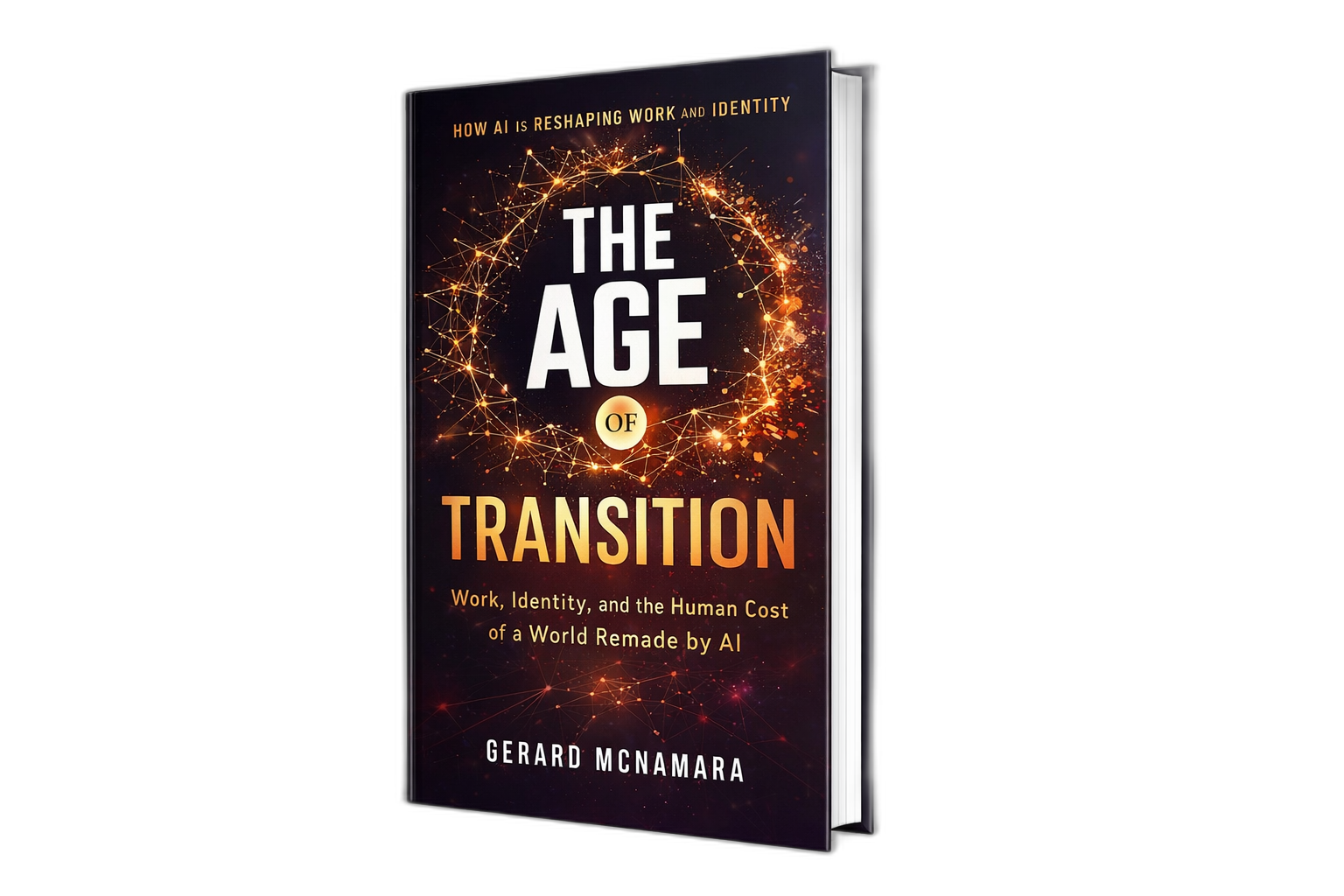
The Age of
Transition
Work, Identity, and the Human Cost of a World Remade by AI
By Gerard McNamara
The first book asked who owns AI. This one asks what it does to us — our work, our identity, and our sense of purpose.
What This Book Is About
“It was not: what is AI doing to our systems? It was: what is it doing to us?”
When I finished writing The Age of Intelligence, I thought I was done. I had set out to make a single argument: that artificial intelligence is not a product, it is infrastructure — and that infrastructure, once embedded in the ordinary workings of life, is almost impossible to dislodge on terms other than those set by whoever owns it.
Then a different question started to follow me around. Not what AI is doing to our systems — but what it is doing to us.
I spent more than thirty years in the high-volume electronics industry. I watched each wave of change move through the companies I worked with, and through the people who worked in them — not as an abstraction, but as a lived experience. People whose skills became redundant almost overnight. The human experience of transition — the loss of identity, the disorientation of purpose — barely got a hearing.
I do not think that is good enough. Not for a change of this scale. So I went looking for the evidence — the actual research record of how work has changed, how people have responded, what governments have done, what has worked, and what has failed.
What the Book Explores
A century of evidence. A forensic look at what is coming. An honest account of what it means to be human when the world of work is remade.
A Century of Transition
Beginning in 1920, tracing what happened when a quarter of the workforce left the land — and what their journey reveals about what is coming now.
The Human Cost
Deindustrialisation, the collapse of the steel towns, the rise of the gig economy — told through the people who lived it, not the economists who measured it.
What AI Will Replace — and Create
A forensically grounded assessment of which jobs are genuinely at risk, how fast the change will come, and what new roles are likely to emerge.
Policy Under Scrutiny
Universal Basic Income, retraining programmes, government responses — examined not as ideology but as evidence. What the trials actually showed.
Identity and Purpose
When the work is gone, income replacement is not life replacement. What decades of research reveal about meaning, connection, and the reason to get up.
Beyond Survival
Under what conditions might a society genuinely thrive in a world with less paid work — rather than simply surviving it?
What Happens When the Work Is Gone?
Not the money. The work. The structure, the identity, the social contact, the sense of contributing to something larger than yourself. The reason to get up.
We have known for decades — from unemployment research and retirement research and the longitudinal studies of communities that lost their economic base — that income replacement is not the same as life replacement. People who lose work do not simply pivot to leisure and flourish. They lose something harder to name and harder to restore.
What I found in the research is that the single most important variable is almost never money. It is meaning. It is connection. It is having something that matters to do, and people to do it with or for.
The systems we are building — the AI systems examined in the first book — are not, by default, designed to provide it. They are designed to be efficient. They are designed to optimise. They are designed to replace the cognitive labour that, until now, gave millions of people their daily sense of worth.
Stay Updated
“A book for anyone who has ever wondered whether the world being built around them was built with them in mind.”
The Age of Transition is forthcoming. For updates on publication, get in touch.
Gerard McNamara · Ireland, 2026